Hi, I’m Collin!
I’m an instructional designer, and I help new employees adapt to company culture while also upskilling & achieving rapid speed to competency.
My special sauce is my ability to focus on both large business goals and individual learners: I am highly strategic and bottom-line oriented, and I am also an empathic teacher and outside-the-box thinker. My balanced approach drives organizational change that ultimately leads to reduced costs, greater profitability, and a healthier company culture.
My work is based in research-backed adult-learning principles and a belief that thoughtfully employed technology can help us scale human-centered learning and development solutions.
Portfolio: Projects and Case Studies
Mill Valley Pasta Co.
Increasing trainees’ speed to competency and reducing trainer time commitment
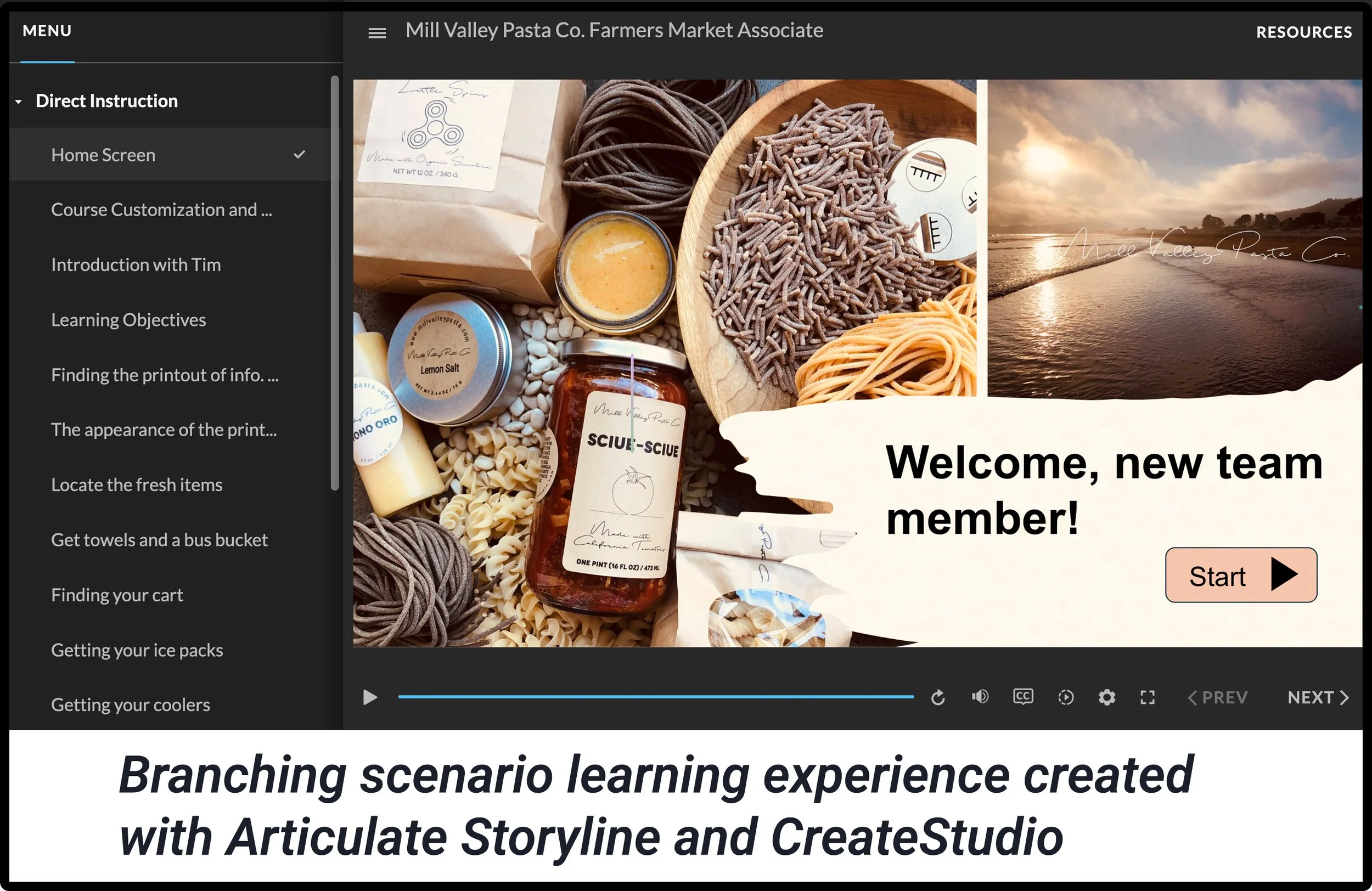
I designed a pre-training for brand-new farmers market associates at Mill Valley Pasta Co. to solve a performance problem that I identified.
Performance Problem: Senior employees had to train new farmers market associates in person in a hand-holding fashion. This ate up a lot of their valuable time and produced inconsistent results, since they were, in a sense, making up the training anew every time.
My Solution: Train new associates on the basics before they arrive for their first shift, and provide them with a job aid aligned to the training—which they bring to their training shifts. This pre-training solution transforms the training role of the senior employee from “sage on the stage” to “guide on the side”: They are available to answer the new hire’s informed questions—referring back to the pre-training and the job aid as they do so—but they no longer need to devote hours of valuable time to one-on-one training.
Goal: Reduce trainer time commitment while also increasing trainees’ speed to competency.
Click the image to see the deliverable and my design process
I designed this training program for students in my First-Year Writing class at San Francisco State University. In this training, students learn the skills needed to use reading to become more skillful, effective writers—in any educational or professional situation.
Performance Problem: Students did not see the connection between reading and writing and, thus, could not use the reading process to improve the quality of their writing.
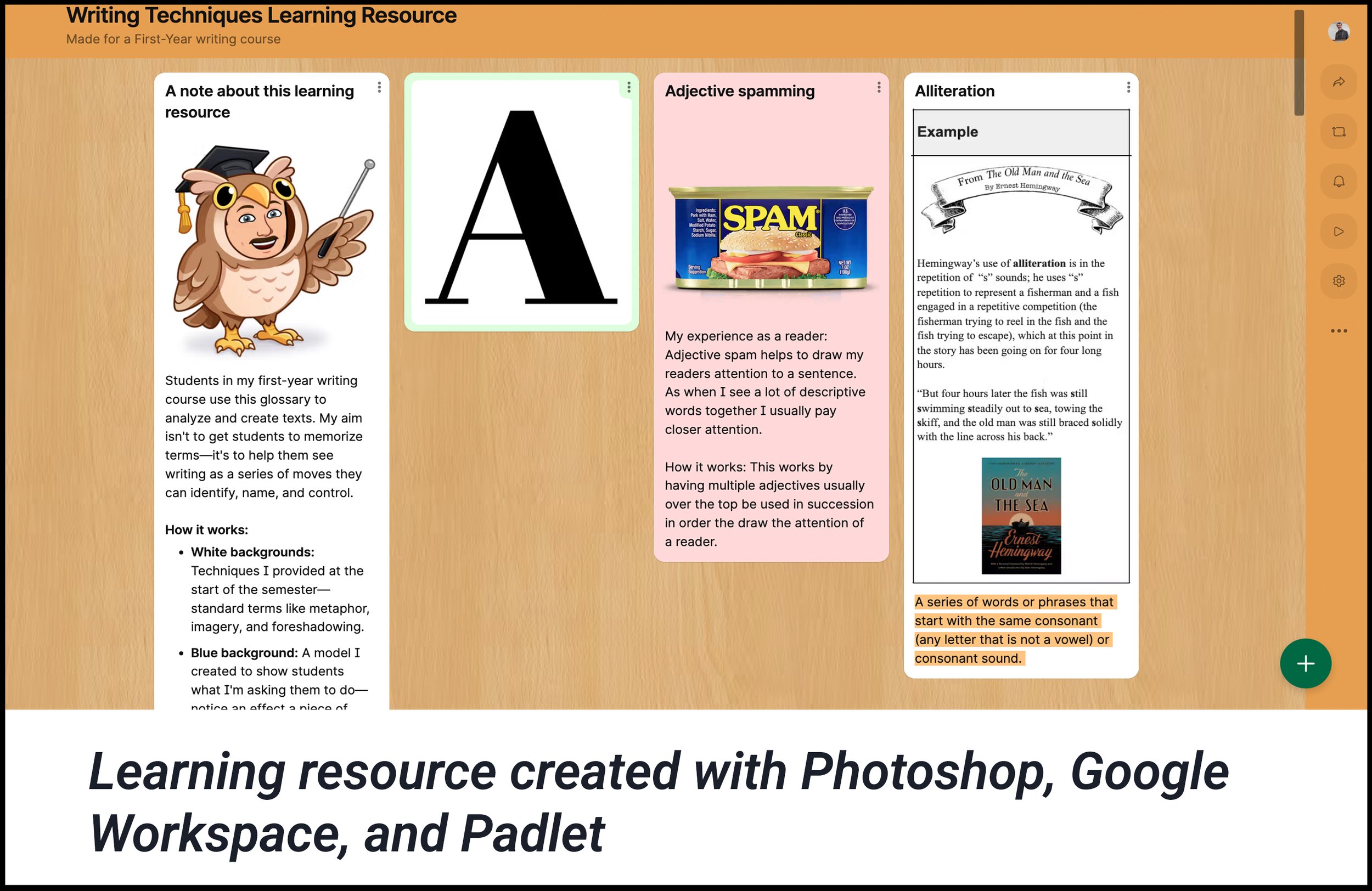
My Solution: Reframe reading as a purposeful process wherein the reader notices techniques that the writer uses, which they then employ in their own writing. I used many EdTech tools to accomplish this, one of which is linked to on the right—a shared Padlet* wall of writing techniques that student writers add to as they take note of effective techniques in the texts they read in the course. This learning resource constitutes an ever-evolving, collaboratively created toolkit that student writers use when they compose their own texts.
Goal: Increase students’ speed to competency as college writers by teaching them to to analyze any type of text for effective techniques, and to then put them to use in their own writing.
Outcome: With greater success as college writers (in my course and others) came greater confidence; and the student retention rate improved.
* Padlet is a collaborative online bulletin board.
Click the explainer video to see some of the key steps in this training program
Click the image to see our collaboratively created writing technique toolkit