
Hi, I’m Collin!
As an instructional designer, I have a proven record of achieving business goals by helping individual learners bridge performance gaps.
At San Francisco State University, a key business goal is improving student retention. To help achieve this goal, I created learner-centered courses designed for use across the Writing Program, facilitated classes, consulted with faculty, and mentored learners and student leaders. This work led to measurable improvement in student performance—a metric that correlates positively with retention.
This example reflects my broader approach: design and facilitation that are both results-oriented and learner-centered. That combination drives organizational change—leading to greater efficiency, better customer service, reduced costs, and an overall healthier culture.
Portfolio: Projects and Case Studies
Mill Valley Pasta Co.
Increasing trainees’ speed to competency and reducing trainer time commitment
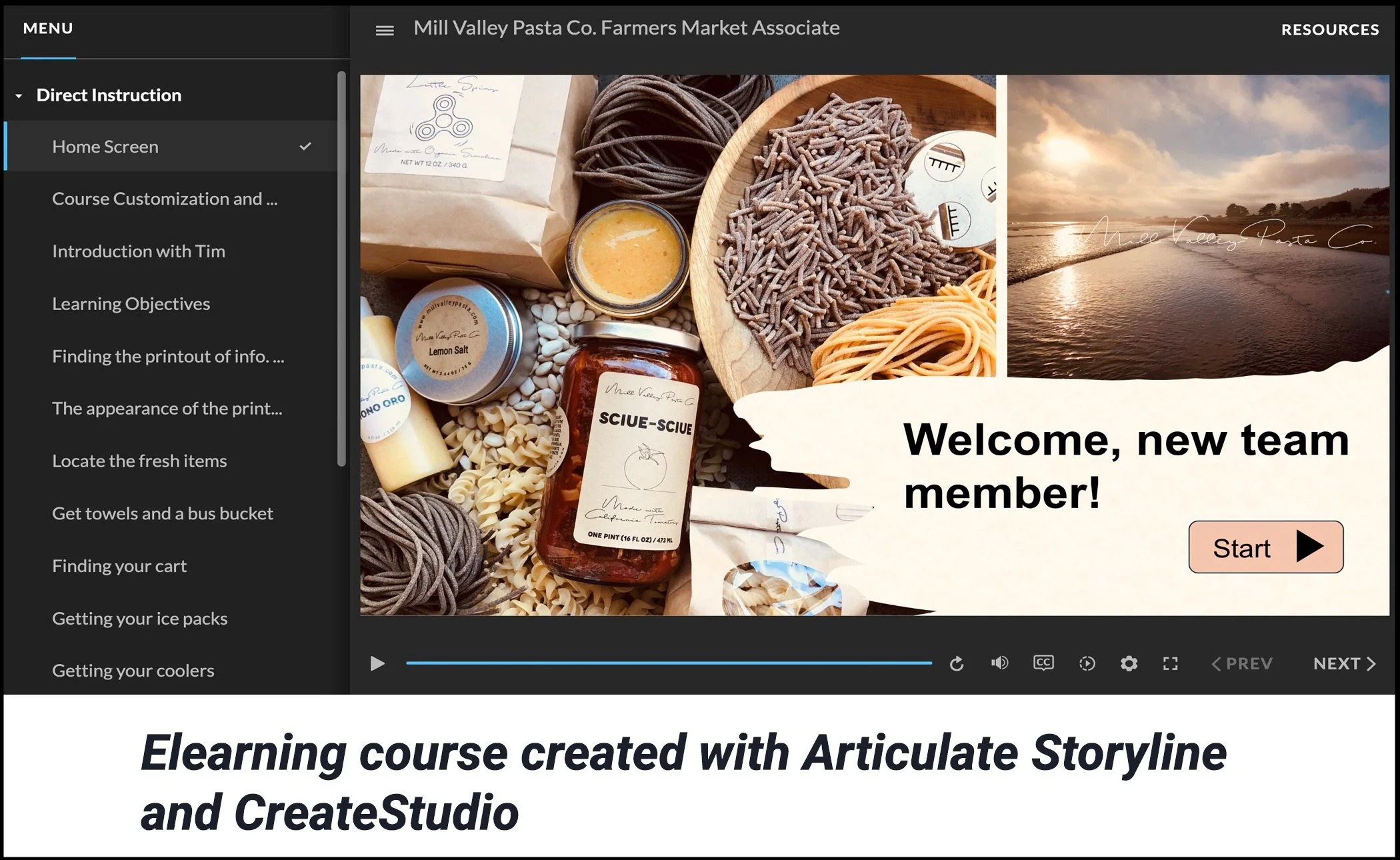
I designed an onboarding course for brand-new farmers market associates at Mill Valley Pasta Co. to solve a performance problem that I identified.
Performance Problem: Senior employees had to train new farmers market associates in person in a hand-holding fashion. This ate up a lot of their valuable time and produced inconsistent results, since they were, in a sense, making up the training anew every time.
My Solution: Train new associates on the basics before they arrive for their first shift, and provide them with a job aid aligned to the training—which they bring to their training shifts. This pre-training solution transforms the training role of the senior employee from “sage on the stage” to “guide on the side”: They are available to answer the new hire’s informed questions—referring back to the pre-training and the job aid as they do so—but they no longer need to devote hours of valuable time to one-on-one training.
Goal: Reduce trainer time commitment while also increasing trainees’ speed to competency.
Click the image to see the deliverable and my design process.
The Pint and Cup Cafe
Improving customer service and increasing sales through scenario-based elearning
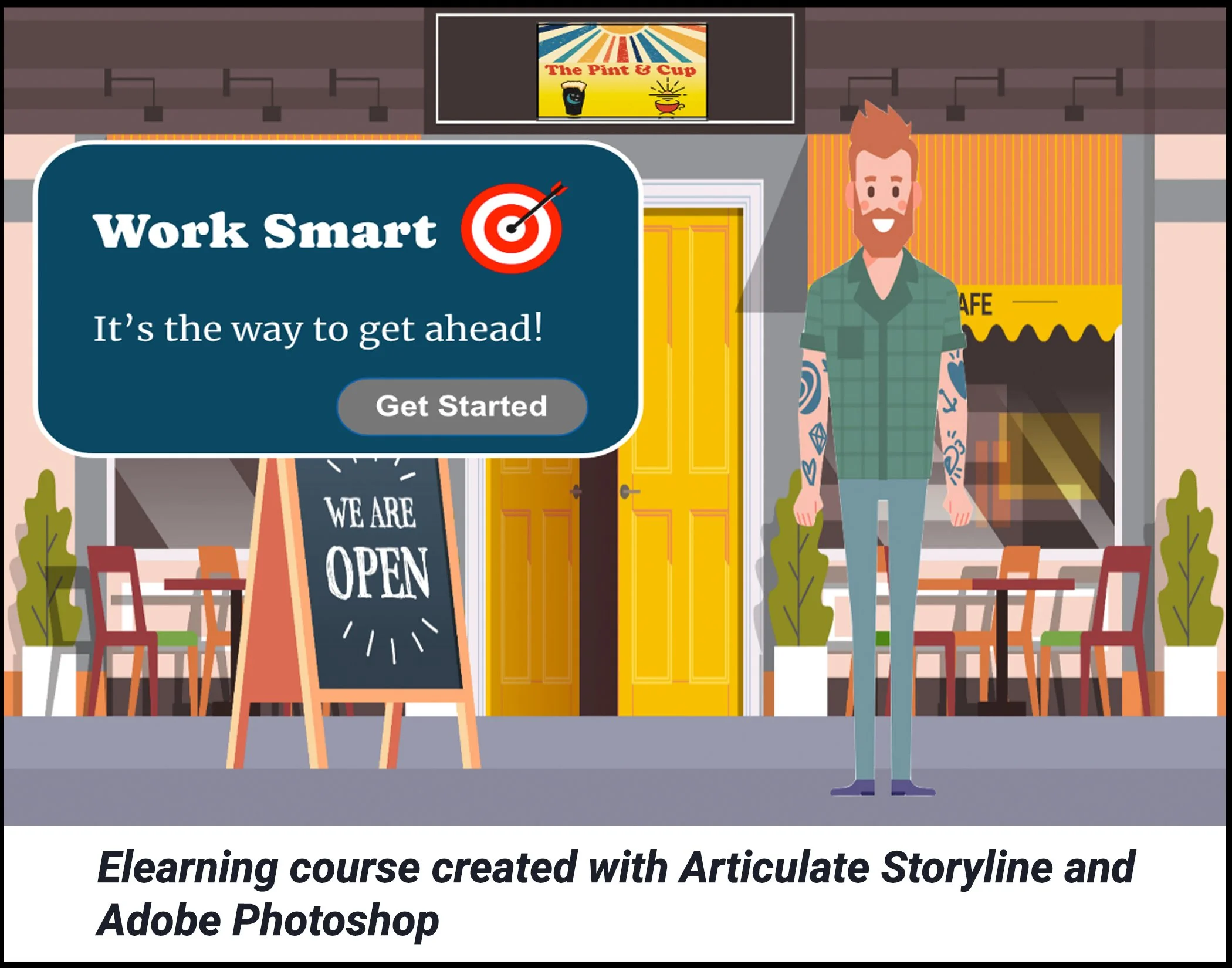
I designed a customer service and safety training for employees at The Pint and Cup, a café and pub in San Francisco, to solve a performance problem I identified through a needs assessment.
Performance Problem: The owner provided employees with a training manual to read on their own time. The manual contained everything employees needed to do their jobs well — but employees weren't reading it. They didn't get paid to read it on their own time, and the owner didn't know. Negative Yelp reviews were increasing and sales were declining.
My Solution: Rather than simply converting the manual into direct instruction, I designed a fully scenario-based elearning course that employees complete during scheduled shifts. Because employees came in with different levels of existing knowledge, I didn't want to force everyone through instruction they didn't need. Instead, the entire course is structured as a branching scenario — learners make choices and experience consequences. For learners who want guidance, I embedded an optional on-demand resource: a small icon that opens a simulated iPhone notes screen with support. The instruction is available for those who need it and invisible to those who don't.
Goal: Decrease negative Yelp reviews by 25% and increase sales by 25% by end of year.
Click the image to see the deliverable and my design process.
San Francisco State University
Bringing instructional design best practices to faculty with no ID background with a custom AI assistant
The Problem: Most faculty at San Francisco State University are subject matter experts, not instructional designers. Without an ID background, it's difficult to know whether a course is truly aligned to its objectives, accessible to all learners, or grounded in established learning principles (such as Bloom's Taxonomy, Universal Design for Learning, and Transparency in Learning and Teaching). The result is courses that are well-intentioned but fall short of best practices—which ultimately affects the quality of the student experience and, with it, retention.
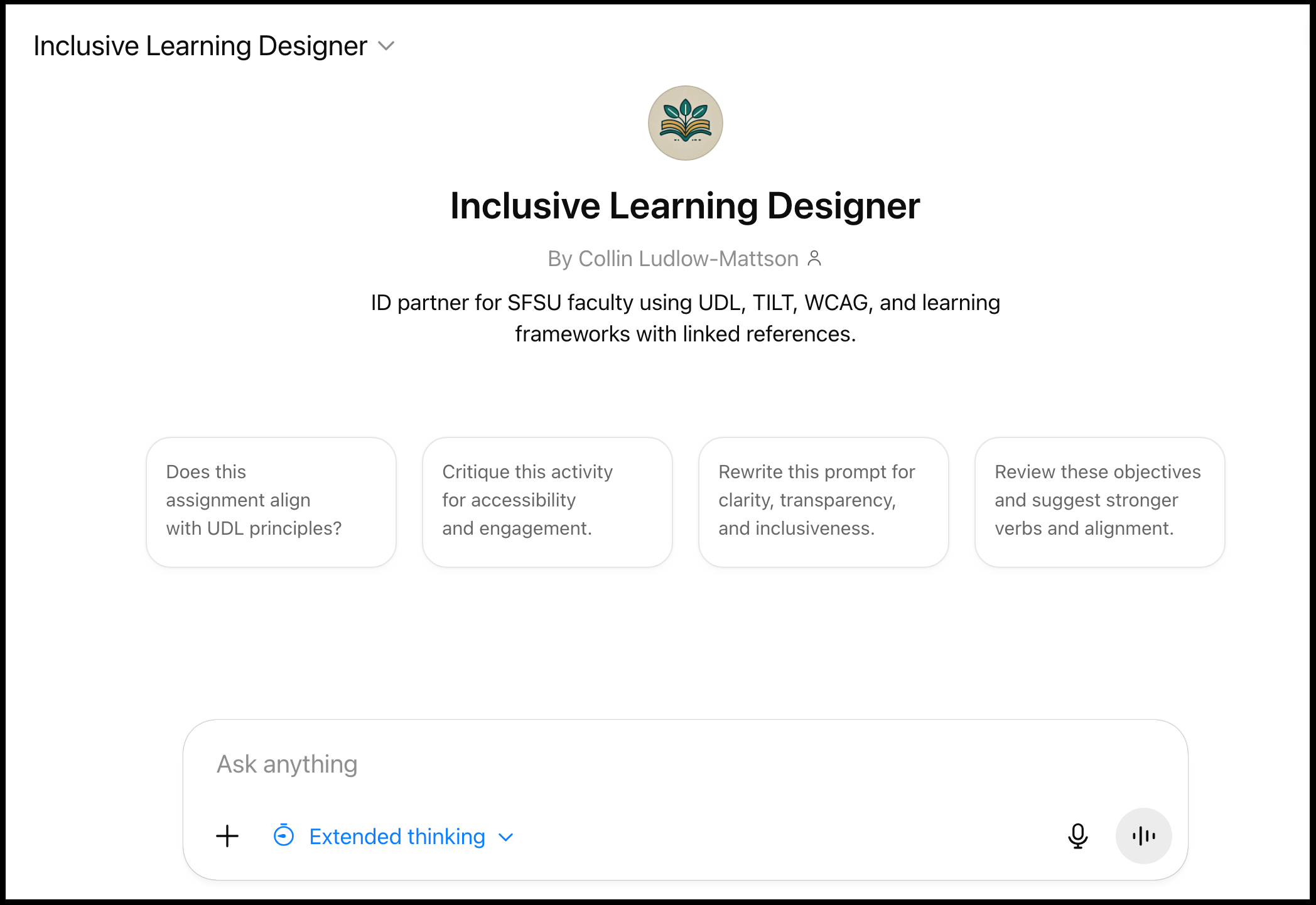
My Solution: I designed a custom GPT called the Inclusive Learning Designer—a purpose-specific AI assistant built around four established instructional design frameworks: Universal Design for Learning (UDL), Transparency in Learning and Teaching (TILT), Web Content Accessibility Guidelines (WCAG), and core learning design principles. Faculty can use it to critique assignments for accessibility and engagement, check alignment between outcomes and activities, rewrite prompts for clarity and inclusiveness, and strengthen learning objectives — and in each case, the tool provides constructive, actionable feedback that guides faculty in making their own revisions, keeping them in the loop as the decision-makers. I deliberately built in guardrails so the tool stays on task and can't be steered off topic—ensuring that every interaction produces reliable, frameworks-grounded guidance. The tool is publicly available and free to use.
The Result: Faculty gained an always-available instructional design resource grounded in best practices—one they could consult at any stage of course design without needing to schedule a consultation or wait for feedback.
Why It Worked: The key design decision was encoding the frameworks into the tool's behavior rather than just its prompts. This ensures the guidance is consistent, accurate, and aligned with established principles—not generic AI output. The guardrails reflect a broader principle I apply to all AI tool design: a well-designed AI tool has a clear purpose, operates within defined boundaries, and keeps a human in the loop on consequential decisions.
Client: San Francisco State University
Role: AI Tool Designer
Scope: Custom GPT Design, Framework Integration, Prompt Engineering, Responsible AI Deployment
Click the image to use the Inclusive Learning Designer on ChatGPT.
San Francisco State University Writing Program
Increasing students’ speed to competency in a First-Year Writing course, and improving student retention (a major business goal of the university)
I designed this training program for students in my First-Year Writing class at San Francisco State University. In this training, students learn the skills needed to use reading to become more skillful, effective writers—in any educational or professional situation.
Performance Problem: Students did not see the connection between reading and writing and, thus, could not use the reading process to improve the quality of their writing.
My Solution: Reframe reading as a purposeful process wherein the reader notices techniques that the writer uses, which they then employ in their own writing.
Goal: Increase students’ speed to competency as college writers by teaching them to to analyze any type of text for effective techniques, and to then put them to use in their own writing.
Outcome: With greater success as college writers (in my course and others) came greater confidence; and the student retention rate improved.
Click the explainer video to see some of the key steps in this training program.
Case Study #1
Increasing the effectiveness of peer review and improving student writing outcomes through structured training
The Problem: In my First-Year Writing courses at San Francisco State University, students consistently struggled with peer review—not from lack of effort, but from lack of training. Most were accustomed to directions like "swap papers and give feedback," which resulted in surface-level praise, vague criticism, and little actionable guidance for revision. Beyond the immediate classroom challenge, there was a business goal at stake: student retention. Writing skills are foundational to college success, and stronger peer review leads to stronger revision—which leads to better writing outcomes and higher course completion rates.
My Solution: I introduced Eli Review, a peer review platform, and designed training around its Describe–Evaluate–Suggest (D–E–S) framework. My aim wasn't simply to use a new tool—it was to make peer review teachable by breaking it into visible, repeatable steps. I combined Eli's self-guided modules with classroom activities, used real feedback samples to build confidence, and provided scaffolding (sentence stems, prompts) that I gradually reduced as students developed fluency. I tracked progress through helpfulness ratings and tied credit to D–E–S proficiency, raising the threshold from 50% alignment early in the term to 90% by term's end.
The Result: Student feedback became clearer, more detailed, and actionable. By the end of the term, 90% of students attempted meaningful revision—not just surface edits—and final essays showed gains in clarity, complexity, and rhetorical awareness. Students reported that D–E–S "made peer review make sense," and some transferred the method to workplace contexts.
Why It Worked: By scaffolding peer review into concrete steps, I helped students see feedback as a skill, not busywork. The result was lasting improvement in writing confidence and revision practices—benefits that extended beyond the classroom.
Client: San Francisco State University — Writing Program
Role: Instructional Designer & Instructor
Scope: Skills Training, Curriculum Design, Classroom Facilitation, Assessment & Feedback Design
Case Study #2
Supporting new writing instructors with a model curriculum
The Problem: At San Francisco State University, new First-Year Writing instructors were expected to design student-centered courses from scratch using the Canvas LMS—often with little guidance or support. This meant long hours spent on prep and inconsistent approaches across sections, and it left instructors with little bandwidth for what matters most: their students. Beyond the immediate challenges, there was a business goal at stake: student retention. Success in first-year courses correlates strongly with retention, so giving students a strong first-year writing experience was an institutional priority.
My Solution: Working with a colleague, I designed a model curriculum for the year-long First-Year Writing "Stretch" sequence that new instructors could adopt or adapt. We created turnkey course materials with embedded instructor annotations (procedural tips, pedagogical reasoning, classroom-tested examples), and we included annotated samples of actual student work to help instructors anticipate what they'd see in the classroom. The complete model course was uploaded to Canvas Commons for program-wide adoption, and we co-facilitated a hands-on onboarding workshop for new instructors who were curious about using the course.
The Result: New instructors spent less time on prep, felt more confident, and had more space to focus on their students. When instructors can focus on their students, students perform better—which supports retention, a key institutional goal. One instructor described the resources as "the most detailed and useful" they had seen, enabling them to "focus on students instead of just staying one step ahead."
Why It Worked: My goal wasn't just to hand instructors materials—it was to design a structure that supported teaching decisions, reduced overwhelm, and encouraged ownership. The model curriculum created a replicable foundation that continues to support instructor success and enhance student learning across the program.
Client: San Francisco State University — Writing Program
Role: Curriculum Designer & Workshop Facilitator
Scope: Model Course Design, Onboarding Support, Workshop Facilitation, Canvas Course Development